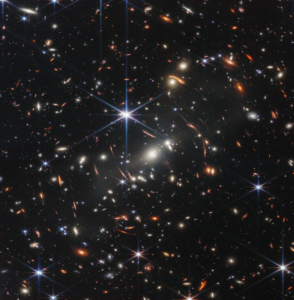
“Is intelligence somehow linked to the quantum-mechanical puzzles described earlier about human observation and reality (and in this chapter, about how the universe seems to be suited to nurture it)? Many increasingly precise experiments have unequivocally proven the certainty of one feature of quantum mechanics: pairs of objects, even those that become remotely separated from one another, have instantaneous, mutual connections.
“Most physicists and philosophers have reached the following conclusion: The only way to obtain these strange results is if one of the following three statements about the nature of the world is wrong: (1) There is an external reality (i.e., an external world independent of observers); (2) faster-than-light communication is impossible (“locality,” at the heart of relativity and our notions of space and time); (3) there is causality (somehow even in quantum processes and measurement). If you are uncomfortable with the mysterious, all-powerful role of the observer to collapse a wavefunction, then all the experiments so far force you to decide which of these three ideas you want to give up: Reality? Locality? Causality?
“If you are comfortable with the Copenhagen Interpretation of wavefunction collapse (it posits that collapse occurs when an observation is made by an intelligent, aware being), then the question becomes whether other intelligent life forms, if they exist, also have this ability. Whether or not any exist is considered next.”
“This is a book for people wondering about modern science and religion, and what each has to say to the other, if anything…. The creation of the universe, quantum physics, and Jewish mysticism are profound and intricate subjects. My strategy is to hold your interest as we navigate among them. While I will not be able to teach you the subtleties of these topics in this small volume, I do hope to explain their essential ideas clearly and painlessly, and I even hope to persuade you that such exploration can intensify your appreciation of this world.
“Modern science and kabbalistic mysticism have provided us with joint insights about our wondrous universe. We on Earth live at the perceived center of the cosmos. All other places share this property, as we saw in the discussion of general relativity, but ours is, nevertheless, a special kind of condition. The Creation itself took place here, as everywhere, ex nihilo from the basic laws of physics. The event occurred 13.7 billion years ago although, paradoxically, it is possible that there was never a time when the universe did not exist.
“We seem to be the purpose of the Creation. Our universe is the way it is, perfect for life, perhaps for our sake. We may be but an infinitesimal speck in the vastness of the cosmos, but the laws of physics and nature that guide the universe established the extraordinary conditions necessary for our existence. We do not know for certain if this circumstance is due to necessity or luck, but we are surely blessed.”

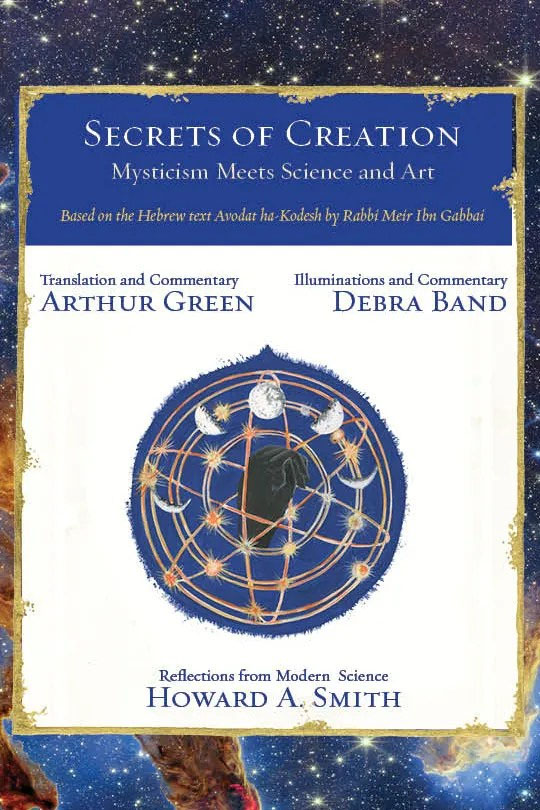
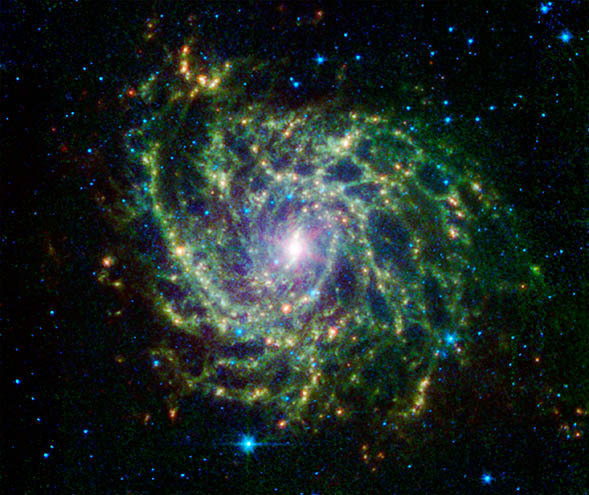 September 2026: Secrets of Creation: Mysticism Meets Science and Art, my new book with theologian Art Green and artist Debra Band, is out! It is an illustrated guide to the mystical Biblical creation with my modern scientific perspective explaining some of the remarkable results in the past few decades in physics and astronomy and why they are relevant. These include quantum discoveries relating the nature of reality, free-will, the impact of gravitational wave and black hole studies, dark matter, entropy and time, and not least the measurements of now over seven thousand exoplanets – planets around other stars. The book is ready to order from Amazon, bookshop, or other outlets and can be ordered from the publisher here: link. See below for some excerpts.